Cambodian Martial Arts
The Living Legacy of Cambodian Martial Arts: Bokator and Kun Khmer
What makes Cambodia’s ancient temples truly extraordinary is not just their breathtaking beauty but what they depict. On the walls of these sanctuaries, frozen in stone for a millennium, are the fighting arts of the Khmer Empire. Archaeologists have identified Cambodian martial art bas-relief sculptures related to Kun Khmer, wrestling, and Bokator at Ta Prohm, Bayon, Angkor Wat, Banteay Samre, Preah Khan, and Prei Temples. These carvings show fighters in dynamic poses, with arms raised in striking positions—undeniable evidence that Cambodia’s martial traditions are as old as its greatest monuments.
Bokator, or Kun Bokator—”the art of pounding the lion”—is an ancient battlefield martial art believed to trace its origin back to the 1st century AD. Oral tradition indicates that Bokator (or an early form thereof) was the close-quarter combat system used by the ancient Cambodian armies before the founding of Angkor. It is one of the oldest fighting systems existing in the world and was formally recognized as intangible cultural heritage by UNESCO in 2022. Formally referred to as lobokkatao, Bokator was developed as a close-quarter combat system and is intricately engraved on the walls of Angkor Wat itself. It encompasses hand-to-hand combat, wrestling, and weapon techniques, incorporating strikes, throws, locks, and submissions based on animal forms. Today, visitors seeking authentic Cambodian martial arts experiences can witness live Bokator demonstrations or even sign up for sessions at dedicated clubs in Siem Reap, where masters teach the fundamentals of this ancient battlefield art.
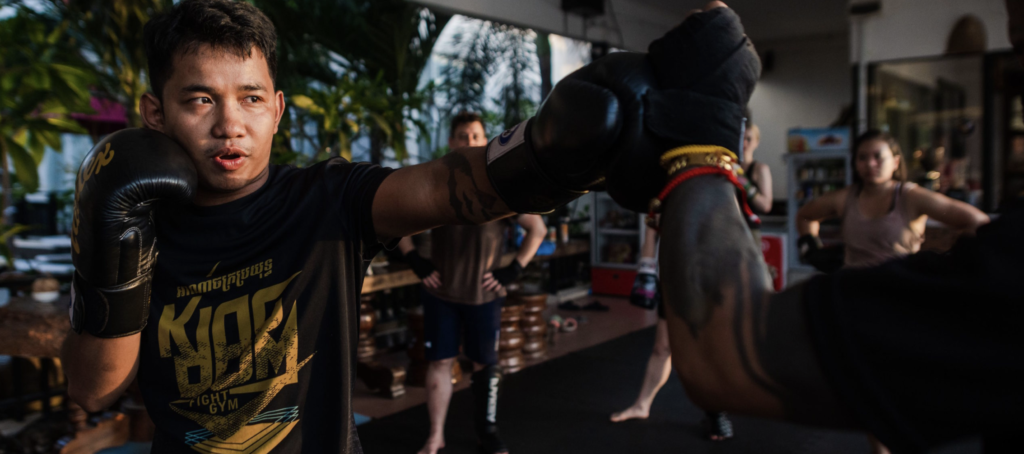
Pradal Serey, also known as Kun Khmer or Traditional Khmer kickboxing, is another martial art that originated in the Khmer Empire. The name translates to “free-style fighting,” reflecting the limited-rules, high-intensity nature of the art. Physical evidence can be found in carvings at Banteay Chhmar Temple, constructed in the late 12th century, where bas-relief artwork depicts figures engaged in combat using instantly recognizable knee and elbow strikes. Modern martial scholars have identified Khmer influences in several Southeast Asian styles, leading them to postulate that Pradal Serey was the primary precursor to muay boran as well as muay Thai. In its early form, strikes using any part of the hands, feet, shins, knees, and elbows were legal—head butts too. Today, Kun Khmer is one of Cambodia’s national sports, with matches consisting of five three-minute rounds. Every weekend, Cambodian television broadcasts these fights, and they are deeply popular among locals. For an authentic cultural immersion, visitors to Phnom Penh can watch live matches ringside at local stadiums, complete with traditional music played on drums, reed flutes, and finger chimes.